

Female, 20s
Full face
Treatment program: Zoom, Collimated
a) Handpiece – 1064㎚ Zoom / 1064nm Collimated
b) Spot size – 6~8 mm
c) Fluence – 1.5 ~1.8J/㎠ / 0.4~0.6J/㎠
d) Repetition – 2 Hz / 10 Hz; e) Pass – 2 passes
Female, 50s
Full face
Treatment program: Zoom, ZMLA
a) Handpiece – 532㎚ Zoom / 532nm ZMLA
b) Spot size – 5 mm / 7mm
c) Fluence – 0.3 ~ 0.5J/㎠ / 0.2J/㎠
d) Repetition – 2 Hz / 5 Hz; e) Pass – 1 pass
Female, 40s
Treatment program: Zoom, VMLA
a) Handpiece – 532㎚ Zoom / 532nm VMLA
b) Spot size – 5 mm / 13mm
c) Fluence – 0.5 ~0.7 J/㎠ / 0.07J/㎠
d) Repetition – 2 Hz / 5 Hz
e) Pass – 1 pass
Male
Leg
Treatment program: Zoom
a) Handpiece – 1064 ㎚ Zoom
b) Spot size – 4 mm
c) Fluence – 1.20 J/㎠; d) Pass – 1 pass
e) Number of treatments – 3
After 3 treatments
Female, 20s
Full face
Treatment program: Zoom, Collimated
a) Handpiece – 1064㎚ Zoom / 1064nm Collimated
b) Spot size – 6~8 mm
c) Fluence – 1.5 ~1.8J/㎠ / 0.4~0.6J/㎠
d) Repetition – 2 Hz / 10 Hz; e) Pass – 2 passes
Female, 50s
Full face
Treatment program: Zoom, ZMLA
a) Handpiece – 532㎚ Zoom / 532nm ZMLA
b) Spot size – 5 mm / 7mm
c) Fluence – 0.3 ~ 0.5J/㎠ / 0.2J/㎠
d) Repetition – 2 Hz / 5 Hz; e) Pass – 1 pass
Female, 40s
Treatment program: Zoom, VMLA
a) Handpiece – 532㎚ Zoom / 532nm VMLA
b) Spot size – 5 mm / 13mm
c) Fluence – 0.5 ~0.7 J/㎠ / 0.07J/㎠
d) Repetition – 2 Hz / 5 Hz
e) Pass – 1 pass
Male
Leg
Treatment program: Zoom
a) Handpiece – 1064 ㎚ Zoom
b) Spot size – 4 mm
c) Fluence – 1.20 J/㎠; d) Pass – 1 pass
e) Number of treatments – 3
After 3 treatments
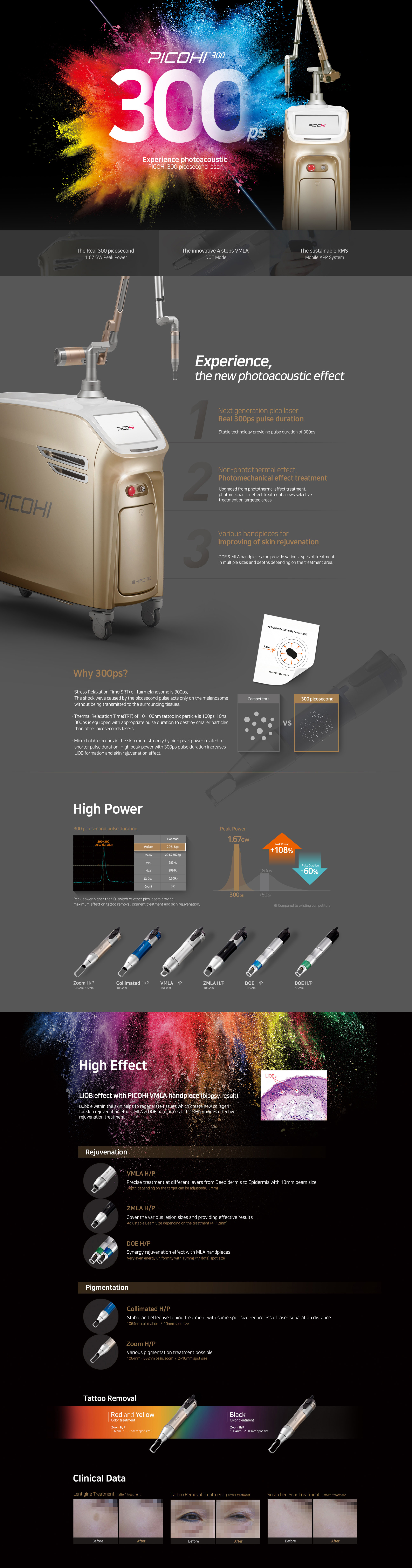
Discover the power of precision with PICOHI™, South Korea's leading picolaser technology. Watch as we delve into its unique 300ps pulse duration and high peak power, showcasing effective treatment for tattoos, melasma, and pigmented lesions while ensuring patient comfort and safety.
Get a sneak peek of the revolutionary PICOHI™ in action. This teaser highlights the laser’s impact on transforming skin care through the advanced LIOB effect for deep rejuvenation and targeted treatment of challenging skin conditions.
PICOHI Seminar at VVIP Partners Meeting 2024. Explore how combining PICOHI™ with other modalities revolutionizes acne scar treatment. This lecture presents practical insights and clinical results from a leading practitioner’s successful strategies.
PICOHI Seminar at VVIP Partners Meeting 2024. Delve into the capabilities of PICOHI™ in transforming skin care for Asians. This seminar showcases the effectiveness of our 300ps pulse duration laser in treating pigmentation disorders and promoting profound skin rejuvenation.
Discover the power of precision with PICOHI™, South Korea's leading picolaser technology. Watch as we delve into its unique 300ps pulse duration and high peak power, showcasing effective treatment for tattoos, melasma, and pigmented lesions while ensuring patient comfort and safety.
Get a sneak peek of the revolutionary PICOHI™ in action. This teaser highlights the laser’s impact on transforming skin care through the advanced LIOB effect for deep rejuvenation and targeted treatment of challenging skin conditions.
PICOHI Seminar at VVIP Partners Meeting 2024. Explore how combining PICOHI™ with other modalities revolutionizes acne scar treatment. This lecture presents practical insights and clinical results from a leading practitioner’s successful strategies.
PICOHI Seminar at VVIP Partners Meeting 2024. Delve into the capabilities of PICOHI™ in transforming skin care for Asians. This seminar showcases the effectiveness of our 300ps pulse duration laser in treating pigmentation disorders and promoting profound skin rejuvenation.
Q01 - Why PICOHI is better compared to other pico laser?
In fact, there is a theoretical curiosity as to whether it would be possible to target melanin at a pulse duration of less than 300 picoseconds, but currently no proven data (papers) can be found. Our PICOHI can be implemented up to 275 within the error range, and it is unknown whether other pico laser is actually effective and produces a stable pico seconds. Moreover, in the case of Picocare, the small number of units sold is evidence that 275ps has not been implemented stably or that there are other problems.
Q02 - What are the differences between PICOHI and conventional lasers, and how does PICOHI distinguish itself from other picosecond lasers?
1. Picolasers are a type of Nd:YAG medium laser and represent the latest and most advanced technology available today. In comparison to other laser technologies, their short Pulse Duration delivers a PhotoMechanical effect rather than the conventional PhotoThermal effect, which minimizes damage to the surrounding tissues near the target lesion. This results in safer procedures and a range of benefits, including tattoo and pigment removal, toning, pore treatment, scar reduction, and skin rejuvenation.
2. Among the latest picolasers on the market, Hironic's PICOHI stands out as a 'Real 300' picosecond laser device, offering the shortest pulse duration of 300 ps (1064 nm) and maximum peak power with stable beam quality. This design maximizes the PhotoMechanical effect, preventing severe damage to surrounding tissues. It is also one of the most stable and effective picosecond laser devices for safely treating target lesions while facilitating skin rejuvenation with various handpieces and the LIOB effect.
Q03 - What is "Photomechanical Effect"?
1. The Nd:YAG main wavelength (1064 nm) belongs to a spectrum with a strong tendency to transmit thermal effects, so it mainly transmits the PhotoThermal Effect,
2. Reliable delivery of a short 300ps Pulse Duration, such as PICOHI, can enhance the physical stimulation effect, the Photomechanic Effect, increasing the protection, stability, and treatment of surrounding tissues."
Q04 - What is "Pulse Duration"? Why it is important?
1. Pulse Duration means the duration of the Laser wavelength or pulse (per reference cycle),
2. The shorter the Pulse Duration, the higher the Max Peak Power can be used for the same energy transfer,
3. This is important because it can deliver effective therapeutic effects and minimize damage to surrounding tissue outside the lesion.
4. The Hironic PICOHI is a device that reliably provides 300ps (1064nm)/275ps (532nm) Pulse Duration, which is rare in the market today.
Q05 - If Pulse Duration is so important, and Hironic PICOHI is superior to it, how much better is it than a competitor?
1. Most domestic/foreign competitors, Pico-Laser, offer 450/600/750 ps at some wavelengths,
2. Q-Switch (ns: nano-sec) Laser is a pulse duration that is incomparable to Laser (15 to 20 times) and is short (PICOHI),
3. The product being marketed at 300ps is also a specification at a wavelength shorter than 1064nm (PICOHI is 300ps at 1064nm),
4. (Based on informal test data) PICOHI alone does not show large stable pulse waveforms and uniform 300ps values (maximum/average/minimum value).If necessary, you can share the video evidence separately.
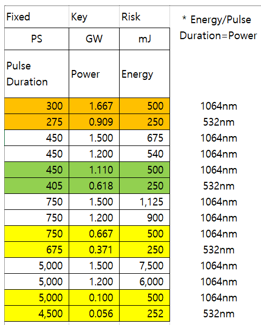
Q06 - What is the relationship among Energy, Max.Peak Power, Pulse Duration? Also, what is the practical meaning of energy and peak power during the procedure?
1. Peak Power = Energy/Pulse Duration
2. Due to a limitation in the range of use, the energy (Damage/Risk) cannot be excessively raised or lowered.
3. Therefore, since the pulse duration is fixed for each device, the lower the pulse duration, the higher the peak power
4. If the pulse duration is longer than 300ps, you can see in the calculation table below,
1) Either the peak power is lower at the same energy,
2) The disadvantage is that the energy becomes incredibly higher at the same peak power.
Q07 - What types of PICOHI handpieces are there and how are they used differently?
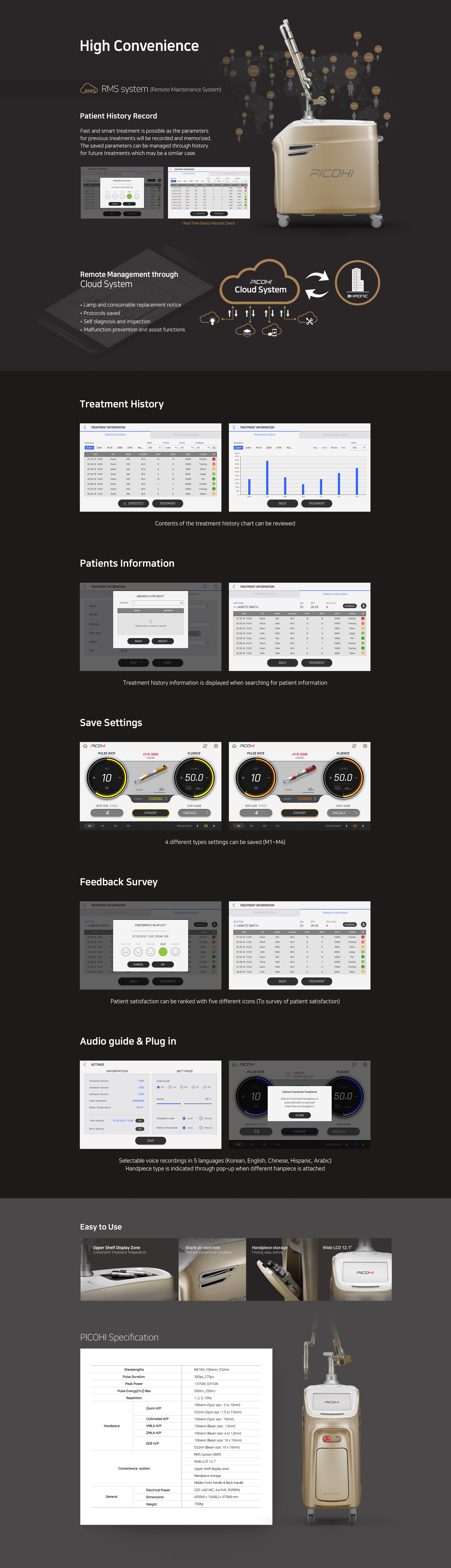
1. In terms of type, there are four types: Zoom (Basic), Collimated, MLA and DOE,
2. A total of six handpieces are available: Zoom, Collimated, VMLA, ZMLA and DOE (1064nm/532nm). The Standard Set contains four (Zoom, Collimated, VMLA, and ZMLA) by default.
3. Zoom/Collimated is primarily used for tattoo/pigmentation improvement, while MLA/DOE is primarily used for skin regeneration.
The materials presented on this platform are exclusively crafted for international use outside of Korea. The specifications and indications for usage of the devices may vary based on regional certifications. For information pertaining to the South Korean market or other specific regions, please consult with our regional managers or authorized distributor representatives in your jurisdiction.
